EQ and Compression: Two Different Questions in a Mix
Equalization and compression are often inserted together, but they answer different questions.
Start reading ↓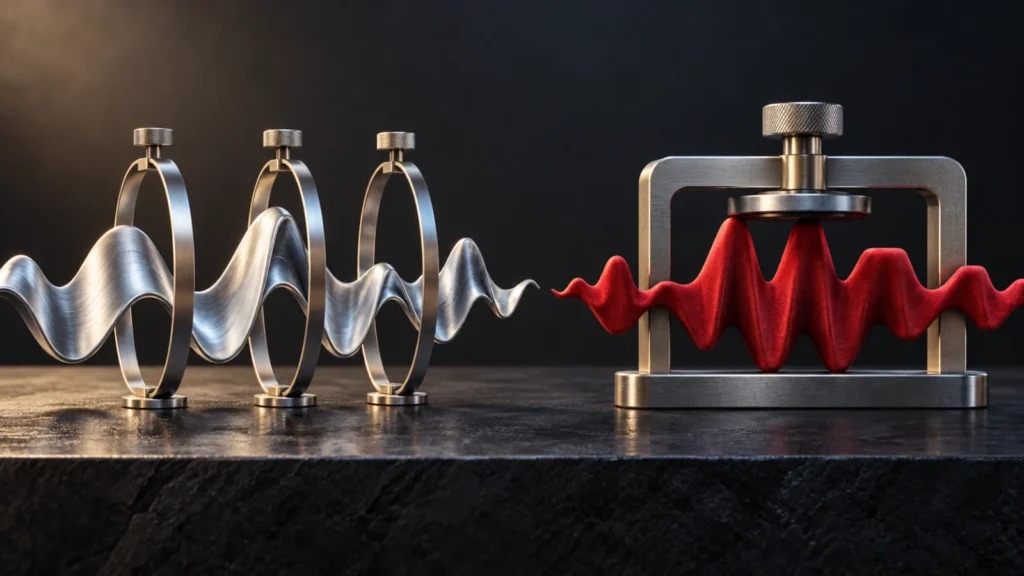
In this guide
Equalization and compression are often inserted together, but they answer different questions. An equalizer changes frequency balance. A compressor changes level behavior according to its design and settings. Learning to describe the problem before selecting a tool prevents a mix from becoming a chain of processors whose purpose nobody remembers.
Describe what you hear in context
Instead of writing needs EQ, identify the issue: a vocal loses clarity when a guitar enters, a bass note dominates one passage or a spoken phrase jumps above its neighbors. The first problem may involve arrangement or frequency balance. The last may involve performance editing, automation or dynamics. More than one solution can be reasonable.
Listen with the surrounding tracks active. A sound that seems impressive alone may be too large for its role in the mix. Conversely, a slightly unusual solo tone may work well in context. Do not let the solo button become the only judge of a production decision.
Use equalization with a purpose
Decide whether you are correcting an unwanted emphasis, creating room for another element or making a deliberate tonal choice. Make a change, compare at similar loudness and check that the important character remains. Avoid treating a frequency chart as an instruction to cut every visible peak.
A filter can remove useful content as well as unwanted content. Listen to the whole phrase and consider the instrument's role. If two parts constantly conflict, an arrangement change may be more effective than increasingly severe equalization. Keep the unprocessed version available for comparison.
Understand the compressor's behavior
Threshold and ratio help determine when and how strongly a typical compressor reduces level. Attack and release influence how that change unfolds, while the detector and other design choices affect the result. Different compressors do not necessarily respond identically to apparently similar settings.
Start with a clear listening target: restrain an occasional peak, shape a transient or make a sustained part more consistent. Excessive processing can change groove, articulation and background noise. Automatic output gain can also make comparison misleading, so listen carefully to level differences when bypassing the effect.
Decide whether a processor is needed
Try clip-level adjustments or automation when only a few phrases need attention. Try a performance or arrangement change when the problem follows the musical structure. The most maintainable mix is not necessarily the one with the fewest plugins, but every processor should have a defensible job.
Record that job in a short note when handing over a session. Key takeaway: choose EQ for an identified tonal relationship and compression for an identified level behavior. Judge the result by the music, not by the number of active devices or the appearance of their curves.
Sources & further reading
Source review: October 29, 2026. This is a researched educational feature, not an interview or a claim of firsthand testing. Legal, health and business decisions require context-appropriate professional guidance.